
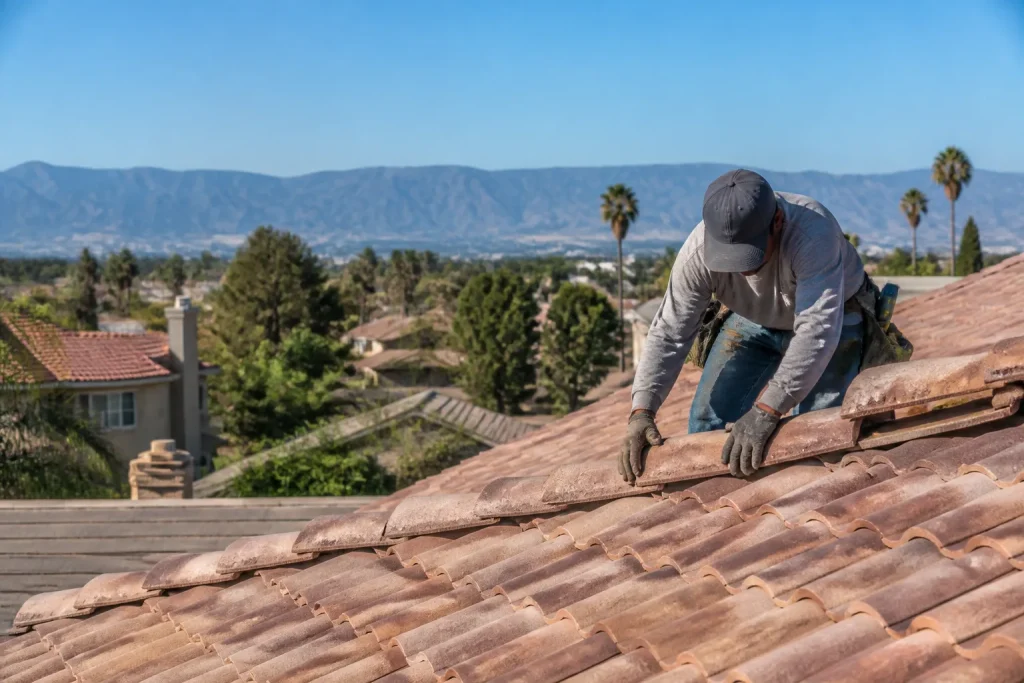
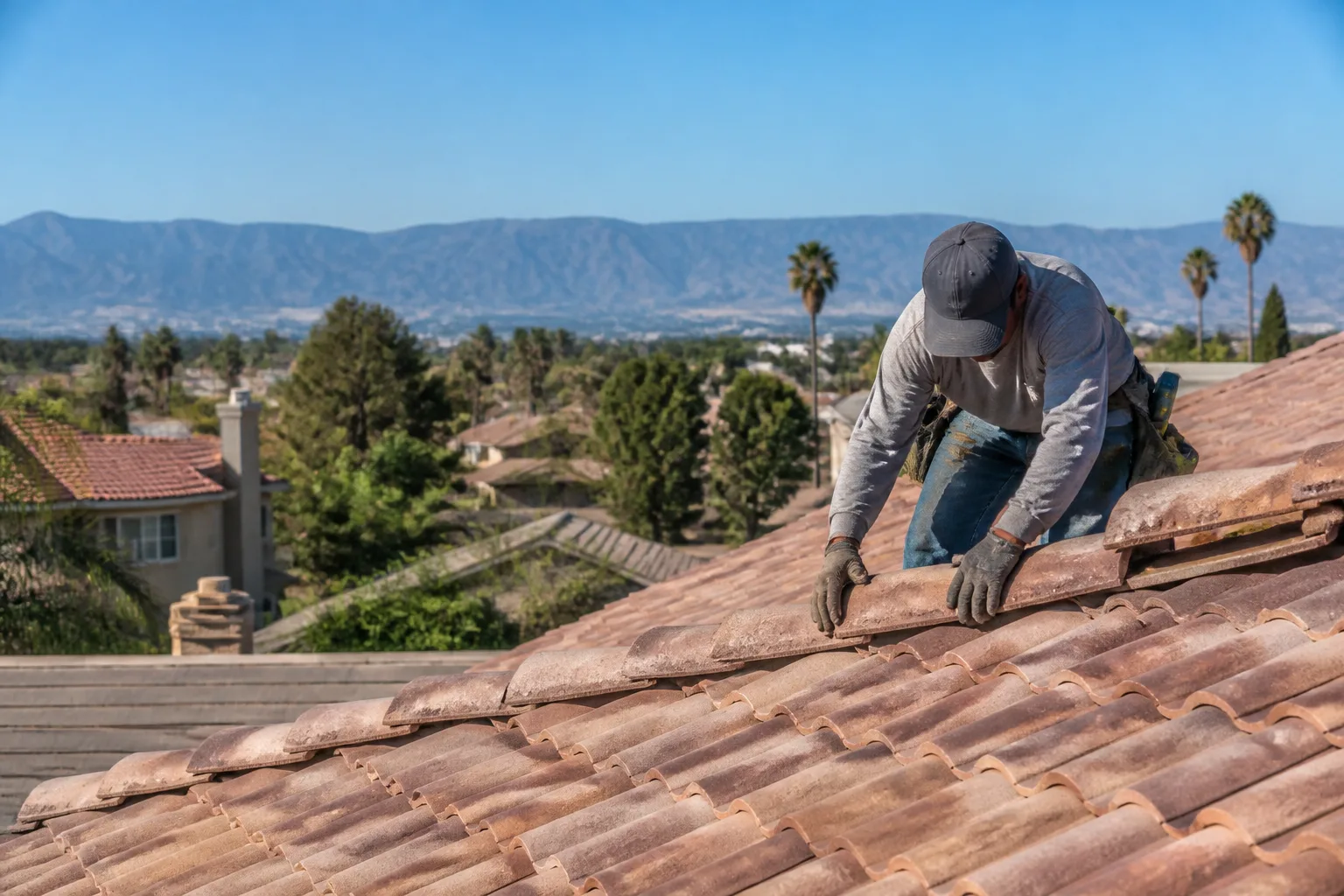
Boral Roof Repair in El Monte: A Homeowner’s Guide
Boral roof repair in El Monte typically costs between $450 and $1,800 depending on whether you’re dealing with a cracked tile, a failed mortar bed, or flashing separation. Most Boral tile failures aren’t actually tile failures at all. They’re underlayment failures, and that distinction changes everything about what the repair should cost and who should do it. If you’d rather skip the reading and get eyes on your roof, call (866) 253-8145 for a free estimate.
Here’s the thing most homeowners don’t know until it’s too late: Boral tile roofs carry 50-year warranties, but the underlayment beneath them is only rated for 20 to 30 years. Thousands of El Monte homes have Boral tile that looks immaculate from the street while the waterproofing layer underneath is fully expired. The tile is doing its job. The layer keeping water out of your house isn’t. That disconnect drives more unnecessary full replacements than any other factor in our local market.
Key Takeaways
- Boral tile itself rarely fails from age. Most “Boral roof repair” calls in El Monte are actually underlayment, flashing, or mortar-bed problems.
- Boral makes three distinct product lines: TileSeal, Duralite, and Saxony. Each requires a different repair approach.
- Color and profile matching depends on the production run year. Discontinued profiles can sometimes be sourced through salvage or Boral’s re-manufacture program, but it’s not guaranteed.
- You can often replace the underlayment without touching the tile. Full teardown isn’t automatic.
- Warranty work has installer-certification requirements. Not every roofer in El Monte can perform warranty-valid Boral repairs.
What Is Boral Roofing, and Why Does It Matter in El Monte?
Boral is an Australian building materials company that made its name in the U.S. roofing market with concrete and clay tile products. In Southern California, Boral tile became a staple on Mediterranean-style, Spanish Colonial, and custom ranch homes. El Monte has a significant stock of these roofs, particularly in neighborhoods developed between 1970 and 2005, where concrete tile was the default choice for builders who wanted a premium look without the cost of genuine clay.
Boral’s appeal is physical and economic. Concrete tile resists impact, holds its color better than asphalt, and carries a 50-year limited warranty for the tile itself. That warranty is genuine. The tile on a 1985 El Monte home may still be doing exactly what it was designed to do. The problem is what’s underneath it, and that’s where most repair conversations start.
We work with seven major roofing material brands: GAF, CertainTeed, Owens Corning, IKO, Atlas, Tamko, and Boral. That matters for Boral-specific repair because our recommendation isn’t tied to what we have in the yard. If your roof needs a Boral match, we source Boral. If your budget points toward a comparable Atlas or Tamko profile, we tell you that honestly. Material choice is a homeowner’s right, not a contractor’s convenience.
The Boral Product Line: TileSeal, Duralite, and Saxony
Boral’s U.S. tile catalog breaks into three main families, and each one behaves differently when something goes wrong.
TileSeal is Boral’s premium concrete tile with an integrated water-shedding barrier built into the tile itself. It’s denser, heavier, and more expensive than standard concrete. When TileSeal fails, it’s almost never the tile. The tile’s internal barrier can outlast the roof deck. What fails is the mortar that holds ridge and hip tiles, or the flashing where tile meets valleys, chimneys, and penetrations.
Duralite is Boral’s lightweight composite tile. It’s made from recycled materials and engineered to weigh significantly less than concrete. Duralite is popular on re-roofs in El Monte where the original concrete tile exceeded the structural load the framing was designed to carry. Duralite cracks more readily than concrete. A dropped tree branch or a careless service tech can shear a corner off a Duralite tile. The upside: Duralite replacement tiles are lighter, easier to handle, and faster to source in current production colors.
Saxony is Boral’s concrete tile line with a lower profile and a consistent, uniform shape. It’s the most common Boral tile we see on El Monte ranch and track homes from the 1980s and 1990s. Saxony issues tend to cluster around original installation weaknesses: inadequate headlap, missing clips, or valley layouts that shed water into the tile instead of into the flashing.
Each line has a different failure fingerprint. A roofer who treats all three as “just tile” will misprice the repair.
Diagnosing What Actually Failed: 4 Distinct Boral Repair Scenarios
Boral roofs fail in four distinct ways, and each requires a different fix. The following comes from what we see across El Monte, specifically, not from a product brochure.
1. Surface crack or broken tile
A cracked surface tile is the most visible failure and the easiest to misread. Concrete tile cracks are usually impact damage: a fallen limb, a satellite dish installation, a roofer walking the tile without proper pads. The fix is straightforward. Remove the broken tile, check the underlayment beneath it for puncture, install a matching replacement tile, and secure it per Boral’s fastener schedule. Cost range: $150 to $400 for a single tile depending on profile and accessibility.
2. Mortar-bed failure
The mortar that locks ridge caps and hip tiles cracks with age and thermal cycling. El Monte’s summer heat expands the mortar. Cooler winter nights contract it. After 15 to 20 years, that cycle loosens the bond enough for water to enter beneath the ridge line. This is the most common Boral repair we do, because the tile looks fine from the street and even from most of the roof surface. You have to inspect the ridge closely to see it. Fix: remove and re-point the affected mortar, replace any crumbling fill, and reseal. Cost range: $600 to $1,200 for a typical El Monte ranch roof.
3. Flashing separation
Flashing is the metal where tile meets vertical surfaces: chimneys, skylights, walls, plumbing vents, and valley intersections. Flashing fails because the sealant degrades, the metal corrodes, or thermal movement pulls the bond apart. The tile doesn’t care. The flashing does. Fix: remove affected tile around the penetration, replace or reseal the flashing, re-bed the tile, and re-secure. Cost range: $400 to $900 per penetration depending on complexity.
4. Underlayment breach
This is the one that turns a $500 repair into a $15,000 conversation. The underlayment is the waterproofing layer between the tile and the deck. Boral tile is not waterproof on its own. It sheds water, but it doesn’t stop it. The underlayment does. When it fails, water reaches the wood deck and starts doing what water does to wood in a dry climate: slow, hidden, compounding damage.
Underlayment failure in El Monte is rarely detected during the dry season. It surfaces during a heavy rain, usually as a ceiling stain, attic dampness, or damp drywall. In Natomas-style El Monte developments with tight lot spacing, we regularly see underlayment failure on north-facing slopes where moss and trapped moisture accelerate the breakdown.
The fix for underlayment failure is more involved, and we’ll cover that in the next section, because it deserves its own conversation.
The Underlayment Replacement Decision: Lift and Relay vs. Full Teardown
If you have a Boral roof with failed underlayment, you have two options, and they’re not interchangeable.
Lift and relay means a crew removes the Boral tile in sections, peels off the old underlayment, replaces it with a modern synthetic material, then re-installs the same tile. The tile doesn’t go anywhere. It comes off, goes on a pallet, and goes back down. This works when the tile is still in good condition and the fastener system is intact. Cost for lift and relay on an average El Monte home runs $12,000 to $18,000 depending on roof complexity.
Full teardown means the tile comes off and doesn’t go back. You replace the entire system: new underlayment, new tile (Boral or a comparable profile from a different manufacturer), new flashing, new ridge. This makes sense when the tile itself is cracked, when you want to change the roof profile, or when the deck needs repair that lift and relay can’t address. Cost runs $20,000 to $35,000 or more for tile in El Monte.
The decision hinges on one question we ask every homeowner: is the tile worth saving? If the tile is sound, lift and relay preserves 70% of your material cost and keeps the original architectural character. If the tile is failing too, teardown is the honest answer, and we’ll tell you that before we ever propose a replacement.
Vista Roof Repair handles both. The same team that inspects the underlayment can do the lift or the teardown. No handoffs, no subs, no second contractor to finish what we started. That continuity matters when you’re moving 8,000 pounds of concrete tile around a roof.
Matching Boral Tile: Production Runs, Discontinued Profiles, and What We Do About It
Boral tile color and profile change by production run. Not by decade. By run. A Saxony tile from a 2003 run in the El Monte distribution network is not identical to a Saxony tile from a 2014 run, even if the color name on the box is the same. Sun fading compounds this: the installed tile has 15 years of Southern California UV exposure. A replacement tile fresh from the pallet will not match. Period.
That’s why repair-matching starts with identification, not assumption. We document the tile profile, measure it, identify the production code, and check color against Boral’s current and historic catalogs. If the profile is still in production, we order the closest available run and blend it across the repair area so the mismatch isn’t obvious from the ground. If the profile is discontinued, we have two options: source matching tile through reclaimed-tile networks in Southern California, or transition to a complementary profile from Boral or a comparable manufacturer like Atlas or Tamko.
Sometimes there’s no acceptable match. That’s when we tell you the truth: the roof can be repaired functionally, but it won’t be visually seamless. Some homeowners accept that. Others choose to replace the visible slope entirely. Both are valid. The point is that you know before anyone touches the roof.
There’s a homeowner lesson in this. If you have a Boral roof, document it. Save a few spare tiles from the original install if you can. Store them in the garage. One homeowner in the El Monte area kept eight spare Saxony tiles from her 1998 build. When a branch cracked two tiles last year, she had original-run replacements sitting in her garage. Her repair cost $300 instead of $900, and it matches perfectly. We pulled those tiles out of her garage and installed them same day.
What Boral’s Warranty Actually Covers (and Who Can Do Warranty-Valid Work)
Boral’s limited warranty covers the tile itself against manufacturing defects. Not installation errors. Not underlayment. Not flashing. Not mortar. The tile. That coverage is real, but it’s narrow, and the claim process carries requirements that trip up unqualified contractors.
Boral requires that warranty work be performed by a contractor with current installer certification from Boral or one of its authorized training partners. A roofer who has never opened a Boral installation manual can void a warranty claim with a single wrong fastener. We’ve seen it happen: a homeowner files a claim, Boral inspects, and denies because the repair used the wrong clip pattern. That’s a five-figure mistake.
When we do warranty-related Boral work, we document everything: the production codes, the fastener schedule, the underlayment specification, the installation pattern. If a claim is warranted, you have the paper trail to support it. If it’s not, you know that too, before you spend money chasing a manufacturer that won’t pay.
Honestly, most Boral failures we see in El Monte aren’t manufacturing defects. They’re age, weather, and installation decisions made 20 or 30 years ago. The warranty conversation is secondary to the actual condition of the roof. We’ll tell you what your roof actually needs, not what a warranty brochure suggests it needs.
When to Call a Pro
You should call a roofer for any of these:
- You see broken, cracked, or slipped tile after a storm or high wind.
- You see mortar crumbs collecting in gutters or at the base of downspouts. That’s ridge mortar failing.
- You notice ceiling stains, even faint ones, after rain. That’s underlayment or flashing, not the tile.
- You can see daylight through the attic in areas where tile meets walls or valleys.
- Your roof is over 20 years old and you’ve never had the underlayment inspected.
The last one is the one we can’t say loudly enough. Underlayment doesn’t announce itself. By the time it shows up as a ceiling stain, the deck has been wet for months. A standalone roof inspection in El Monte costs a fraction of what underlayment replacement costs, and it tells you whether you have a problem now or one brewing.
Related services in El Monte
If you’re dealing with a specific issue, these pages cover the range: Roof Repair in El Monte, Roof Replacement in El Monte, and Roof Inspection in El Monte.
The Bottom Line
Boral roof repair in El Monte is a real specialty, and it’s not the same as generic tile repair. The tile is usually fine. The underlayment, flashing, and mortar are usually not. Knowing which one failed determines whether you’re looking at a $300 fix, a $1,500 fix, or a $15,000 fix. Most roofers in this market price Boral repairs without making that distinction, and that’s how homeowners end up paying for a full replacement when a lift and relay would have preserved a perfectly good tile roof.
If you’re in El Monte and need a Boral roof assessed honestly, Vista Roof Repair home is the place to start. We offer free estimates, we do standalone inspections without pushing replacement, and we’ll tell you what your roof actually needs. Call (866) 253-8145 to schedule.
Frequently Asked Questions
How much does Boral roof repair cost in El Monte?
Boral roof repair in El Monte typically runs between $450 and $1,800 for common issues like cracked tile, mortar re-pointing, or flashing separation. Underlayment replacement is a separate category and runs $12,000 to $18,000 for a typical lift and relay. Call (866) 253-8145 for an exact quote, as your repair estimate should be based on your specific roof profile and condition.
Can you replace Boral tile with a different brand?
Yes. Boral tile can be matched with comparable profiles from other manufacturers like Atlas or Tamko, especially when discontinuation or budget factors matter. The key is color blending and profile compatibility. We’ll show you options and let your budget, not our inventory, drive the recommendation. Call (866) 253-8145 to discuss what would work on your roof.
Does Boral’s warranty cover underlayment failure?
No. Boral’s limited warranty covers the tile itself against manufacturing defects. Underlayment, flashing, mortar, and installation workmanship are not covered. If you’re experiencing a leak on a Boral roof, the source is almost always one of those non-warranty components. Call (866) 253-8145 for a free inspection to identify the actual failure point.
How long does a Boral roof repair take in El Monte?
Simple tile replacement or mortar work is done in a day. Flashing replacement takes one to two days. Underlayment lift and relay typically takes three to five working days depending on roof size and El Monte weather. We’ll give you a written scope and timeline before any work begins. Call (866) 253-8145 to schedule your free estimate.
Written by the team at Vista Roof Repair, serving El Monte since 2017.
Need Roofing Help?
Call Vista Roof Repair — licensed & insured, here with fast after-hours help in La Habra.
(866) 253-8145